Sharps Kiosk
Kiosks available in
Beulah & Mandan
♦ ♦ ♦ ♦ ♦
Coal Country
Community Health Center
1312 Hwy. 49 N., Beulah
♦ ♦ ♦
Western Plains Public Health
403 Burlington Street SE, Mandan
♦ ♦ ♦
Kiosks available in
Beulah & Mandan
♦ ♦ ♦ ♦ ♦
Coal Country
Community Health Center
1312 Hwy. 49 N., Beulah
♦ ♦ ♦
Western Plains Public Health
403 Burlington Street SE, Mandan
♦ ♦ ♦
Western Plains Public Health consults with schools on communicable disease control and follow-up, immunizations, health education for students and staff, vision screening, oral health, and may assist with the development of health plans for children with special health needs.
Please contact your local Western Plains Public Health office for more information.
Available Resources:
Vision Assistance: VSP Eyes of Hope (formerly Sight for Students) Program will pay for an exam and one pair of glasses for qualifying students. Contact your local Western Plains Public Health office for more information.
Insurance: Medicaid and the Children's Health Insurance Program (CHIP) provide no-cost or low-cost health coverage for eligible children in North Dakota. These programs provide health coverage for children so that they can get routine check-ups, immunizations and dental care to keep them healthy.
Even if your child has been turned down in the past or you don't know if they qualify, you may be able to get health coverage now.
For more information call 1-800-755-2604 (Medicaid) or 1-800-318-2595 (CHIP) or visit Insure Kids Now.
Immunizations Required for Child Care & School Attendance: Immunizations are available from your healthcare provider or from your local Western Plains Public Health office. Click here to view immunization requirements.
Disease Fact Sheets: The ND Department of Health and Human Services provides fact sheets for various diseases and conditions.
Click here to view facts sheets.
Who?
Available to anyone who is pregnant with their first child, meets income requirements, and lives in one of the 6 counties in our service area. The mother must enroll before 29 weeks pregnant.
Your nurse will support you to:
Nurse-Family Partnership is sponsored by PCAND. This program is supported by the Health Resources and Services Administration (HRSA) of the U.S. Department of Health and Human Services (HHS). The contents are those of the author(s) and do not necessarily represent the official views of, nor an endorsement, by HRSA, HHS or the U.S. Government.
SERVICE AREAS
Burleigh County:
Jessica Linneman, RN
Michelle Allex, RN
Liz Kapella, RN
Grant, Mercer, Morton,
Oliver & Sioux Counties:
Chelsey Trebas, RN, CLC
Tuberculosis (TB) is a bacterial disease that is spread through the air. This happens when
a person with TB disease coughs, sneezes, speaks, or sings.
TB can also affect other parts of the body such as the brain, lymph nosed, kidneys, bones, joints,
larynx, intestines or eyes, which is referred to as extrapulmonary.
Symptoms: cough lasting 3 weeks or longer, pain in the chest, coughing up blood or sputum,
weakness/fatigue, weight loss, fever, chills, night sweats
Screening for TB is available through a simple blood draw.
For more information on Tuberculosis visit: hhs.nd.gov/tuberculosis
Chlamydia is a common bacterial STI that can cause an infection in women and men.
*If you have had a previous chlamydia infection and were treated, you can get infected again.
*If you are pregnant, you can pass chlamydia to your baby during a vaginal delivery.
How it’s spread: By having unprotected vaginal, anal, or oral sex.
Signs/Symptoms: Often has no symptoms, but it can cause serious health problems even without symptoms.
Women—Abnormal vaginal discharge, A burning sensation when peeing
Men—Discharge from the penis, A burning sensation when peeing, Pain and swelling in one or both testicles (this is less common)
Rectal Infection: Rectal pain, Discharge, Bleeding
Who should get tested?
If you are sexually active and have any of the following risk factors, you should be tested at least once a year.
Gay or bi-sexual women and men
Men who have sex with other men
Have a new sex partner
Persons that have multiple sex partners
Persons that have a sex partner who has an STI
You are pregnant
Gonorrhea is a common bacterial STI that can cause an infection in women and men.
*If you have had a previous gonorrhea infection and were treated, you can get infected again.
*If you are pregnant, you can pass gonorrhea to your baby during a vaginal delivery.
How it’s spread: By having unprotected vaginal, anal, or oral sex.
Signs/Symptoms: Often has no symptoms, but it can cause serious health problems even without symptoms.
Women—Painful or burning sensation when peeing, Increased vaginal discharge, Vaginal bleeding between periods
Men—Burning sensation when peeing, A white, yellow, or green discharge from the penis, Painful or swollen testicles (this is less common)
Rectal Infection: Discharge, Anal itching, Soreness, Bleeding, Painful bowel movements
Who should get tested?
If you are sexually active and have any of the following risk factors, you should be tested at least once a year.
Gay or bi-sexual women and men
Men who have sex with other men
Have a new sex partner
Persons that have multiple sex partners
Persons that have a sex partner who has an STI
You are pregnant
Syphilis is a bacterial STI that can cause an infection in women and men.
*If you have had a previous syphilis infection and were treated, you can get infected again.
*If you are pregnant, you can pass syphilis to your baby during pregnancy.
How it’s spread: Direct contact with a syphilis sore during vaginal, anal, or oral sex. It can be spread from a mother to her unborn baby.
Signs/Symptoms:
Primary—Single or multiple sores in the location of contact. They can be painless. The sore(s) will go away on their own in 3-6 weeks. These usually occur in, on, or around the Penis, Vagina, Anus, Rectum, Lips or in the mouth
Secondary—Skin rashes and/or sores in the mouth, vagina, or anus. The rash can be on the palms of your hands and/or the soles of the feet. These will go away on their own.
Other s/s: fever, swollen lymph nodes, sore throat, patchy hair loss, headaches, weight loss, muscle aches, and feeling very tired.
Latent—There are no visible signs or symptoms. Without treatment, you can continue to have syphilis in your body for years and can spread it to others.
Who should get tested?
If you are sexually active and have any of the following risk factors, you should be tested at least once a year.
Gay or bi-sexual women and men
Persons living with HIV
Persons taking pre-exposure prophylaxis (PrEP) for HIV prevention
Persons that have a sex partner who tests positive for syphilis
You are pregnant
Hepatitis C is a liver infection caused by the hepatitis C virus (HCV). Hepatitis C
is spread through contact with blood from someone that has hepatitis C.
How it’s spread: Hepatitis C is spread through contact with blood from someone
that has hepatitis C.
Who should get tested?
*Testing should be completed at least annually but recommended every 3-6 months.
NDHHS Hep C: hhs.nd.gov/viral-hepatitis
HIV/AIDS
HIV (human immunodeficiency virus) is a virus that attacks the body's immune system. Without treatment, it can lead to AIDS (acquired immunodeficiency syndrome).
There is currently no effective cure. Once people get HIV, they have it for life. But proper medical care can control the virus.
How it’s spread: Most people who get HIV get it through anal or vaginal sex, or sharing needles, syringes, or other drug injection equipment.
Only certain body fluids can transmit HIV, including:
Blood
Semen
Pre-seminal fluid
Rectal fluids
Vaginal fluids
Breast milk
Who should get tested?
Persons having sex with someone living with HIV (PLWH)
Persons that have had more than one sex partner since last HIV test
Persons who injected drugs
Persons who exchange in sex work
Persons diagnosed with or had treatment for tuberculosis (TB), HCV or an STI
Persons who have sex with someone that uses injection drugs
Persons that have sex with someone who exchanges in sex work
Persons that have sex with someone whose sexual history is unknown (i.e. anonymous sex partners, one night stand)
Persons that get tattoos or body piercings in unsterile environments
ND Ryan White Part B Program provides assistance to ND residents living with HIV/AIDS to access confidential health and support services.
To enroll, contact Western Plains Public Health.
Why is it important to immunize? Vaccines protect children and adults against potentially disabling and life-threatening disease. Immunization has saved more than a billion lives and prevented countless illnesses and disabilities. However, vaccine-preventable diseases are still a threat and continue to infect children and adults, resulting in hospitalizations and deaths every year. Take the steps today to help prepare for a healthier tomorrow.
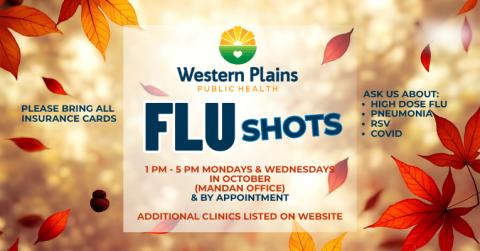
IMMUNIZATION CLINICS:
Please call the appropriate office to schedule an appointment.
IMMUNIZATIONS PROVIDED
COVID-19, DTaP, Hepatitis A, Hepatitis B, HIB, HPV-9 (Gardasil), Influenza (Flu) - seasonal, MenB (Bexsero), Meningococcal (MCV-4), MMR, Nirsevimab (RSV for infants), Pneumococcal, Polio, RSV (Adult only), Rotavirus, Tdap, Varicella (Chickenpox), Zoster (Shingles)
Learn More About Immunizations
Western Plains Public Health can bill the following insurances:
♦ Blue Cross Blue Shield
♦ Champ VA
♦ Cigna
♦ Humana
♦ Medica
♦ Medicaid
♦ Medicare
♦ Sanford
♦ Tricare West Region
♦ United Healthcare
If you have an insurance other than what is listed above, WPPH can still provide immunizations. Please note we would collect payment for the cost of vaccine and administration fee at the time of service.
If you are uninsured/underinsured, you may qualify for vaccine assistance. Please contact your local office if you have questions.
Recommendations & Requirements
Adult (General Recommendations)
Children (Birth through 6 Years)
Children (7 years through 18 years)
Childcare & School Requirements
Additional Resources
North Dakota State Immunization Program
Home Visiting-Health Maintenance services are provided by Registered Nurses to individuals who live in Grant, Mercer, Morton, Oliver, and Sioux counties. Clients are accepted into the program based on the reasonable expectation that their medical, nursing, and social needs can be adequately met safely in their place of residence. Potential clients have the right to accept or deny services.
Referrals may be made by individuals, family, professionals or others who believe there is a need. Care is coordinated with your health care provider. Costs for services are set by a sliding fee scale.
Potential Clients:
Services Include:
Home Visiting-Health Maintenance Client Rights and Responsibilities
NEW CLIENT enrollments are encouraged
to come at the start of clinic hours.
The first appointment will take
approximately 1 hour (please plan accordingly).
CLINIC REMINDER: The Good Neighbor Project is a
walk-in-clinic and waiting times will vary (please plan accordingly).
Beulah Office: 1101 3rd Ave NW, Beulah
To set up an appointment, please call 701.873.4433
The Good Samaritan Law protects you so you can protect your friend. |
|---|
|
|---|