Within Banner

Accessibility

Western Plains Public Health’s Commitment to Accessibility

Western Plains Public Health is committed to ensuring that individuals with disabilities have equitable access to our information and services, as mandated by Century Code, the Americans with Disabilities Act (ADA), Section 504, and Title II. This includes all digital content—such as webpages, documents, forms, and multimedia—available via our public platforms.

We strive to meet accessibility standards, including Web Content Accessibility Guidelines (WCAG) 2.1 Level AA, as well as Web Accessibility Initiative – Accessible Rich Internet Applications (WAI-ARIA). Our agency continuously evaluates digital content in an effort to maintain ADA compliance, following industry best practices that help ensure content is:

  • Perceivable: Content must be easy for people to see, hear, or otherwise sense.
  • Operable: People must be able to use websites and tools in different ways, such as by keyboard or assistive technology.
  • Understandable: Information and instructions should be clear and easy for everyone to follow.
  • Robust: Content should work well with modern technology and continue to work with future tools and assistive devices.

By adhering to these standards, we affirm our commitment to creating an inclusive digital environment, one in which every citizen can independently access, understand, and benefit from the information and services our state provides.

We Appreciate Your Feedback

If you encounter any barriers while using this website, we want to hear from you. Please report any accessibility issues by calling 701-667-3370 or submitting a Contact Form.

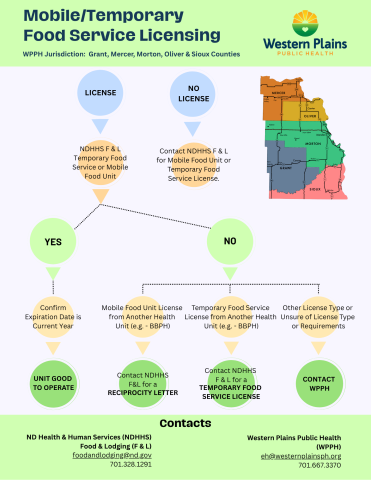
Temporary Food

Food truck

Did you receive an Environmental Health Service from us this year? 
We want to hear from you!

Take our quick survey and let us know how we did — your feedback helps us improve our services and better support our community. 

🗓 Survey deadline: January 31, 2025
🔗Take the survey: s.surveyplanet.com/fnl6hb5a

Thank you for sharing your thoughts! 💚


Image
Food Service Licensing Flowchart 7.2025


     Temporary Food Event Coordinator Application


Services Provided In:
Grant, Mercer, Morton, Oliver,
and Sioux Counties

Contact:
Lana Schmidt, REHS/RS
Emily Pearson, REHS/RS
Sarah Uskevicz, EHP
eh@westernplainsph.org


RESOURCES:

Temporary Food Guide

Food Handler Guide


Narcan Training

hearts


Image
Naloxone


                     FREE NARCAN TRAINING
       Presented by Western Plains Public Health

*Must be 18 years or older

*Training is approximately 45 minutes

*Available for individuals & group settings

*To schedule your free training, submit your request form today!


   For more information on opioid Safety, Overdose & Addiction, visit:
                                  hhs.nd.gov/opioids

What is your preferred method of contact?
CAPTCHA
This question is for testing whether or not you are a human visitor and to prevent automated spam submissions.

Parent Resources

teen and dad
Image
Parent Resources


YOUTH QUITTING PROGRAMS

  • My Life My Quit – Assists people under the age of 18 who are addicted to nicotine through cigarettes, chew, or e-cigarettes/vaping devices through a free and confidential program.  Call 1.855.891.9989, text "Start my quit" to 36072 for real-time coaching or visit 
    nd.mylifemyquit.org/en-us


RESOURCES

Careers

January 2, 2026: We are not currently hiring.

Western Plains Public Health has a wide range of benefits and perks such as:

  • NDPERS retirement plan
  • 100% paid health insurance plan (single and family)
  • Dental and Vision insurance
  • Flexible work schedule
  • Family friendly

We would love to have you as part of our team!

If you have any questions regarding our open positions or future positions, please contact our administrator, Erin Ourada, at 701.667.3370 or eourada@westernplainsph.org.


Image
public health nurse testimonial

Environmental Complaint

Western Plains Public Health environmental health practitioners will inspect public health nuisances under the authority granted through North Dakota Century Code 23-35-09. A public health nuisance can be defined as a condition, activity, or situation that interferes with the use or enjoyment of property and is injurious to health. The nuisance is a public issue when it unreasonably interferes with a right common to the general public. Examples may include breeding areas for flies, collection of sewage, water serving as a mosquito breeding area, rat harborages, bed bugs and other mediums of disease transmission.

If you are aware of a public health nuisance, source of filth, and/or cause of sickness, please call our office at 701-667-3370 or complete the webform.

One file only.
100 MB limit.
Allowed types: gif, jpg, jpeg, png.

Winter Preparedness

Snow storm

Each year, winter weather affects North Dakotans on a broad scale, ranging from travel inconvenience to death. However, you can benefit from preparation and making sure you are ready for the wintry season the region is notorious for. Winter storms can give advanced warning or occur suddenly, and a proactive approach, versus a reactive one, can help ensure your safety.

Terminology

  • Blizzard Warning – Issued when an expected blizzard event with sustained winds or frequent gusts greater than 35 mph will accompany blowing snow for three or more hours.
  • Blizzard Watch – Issued when conditions are favorable for severe winter weather.
  • Freezing Rain – Precipitation that creates a coating of ice on roads and walkways.
  • Frost/Freeze Warning – Issued when below freezing temperatures are expected.
  • Hypothermia – A health hazard when your body temperature sinks below 96 degrees Fahrenheit.  
  • Sleet – Rain that turns to ice pellets before reaching the ground.
  • Wind Chill – The perceived temperature due to weather conditions.
  • Winter Weather Advisory – Issued when snow, blowing snow, ice, sleet or a combination of wintry elements are expected but conditions should not be hazardous enough to meet warning criteria. Use cation when driving.
  • Winter Storm Watches – Issued when conditions are favorable for a significant winter storm event. Heavy sleet, heavy snow, ice storms, blowing snow or a combination of wintry elements are possible.
  • Winter Storm Warning – Issued for significant winter weather events including snow, ice, sleet, blowing snow or a combination of wintry elements. Travel will become difficult or impossible in some situations. Delay travel plans until conditions improve.

Communication Plan

  • List contact numbers such as hospitals/clinics, doctors, schools or service providers, as well as family members and neighbors.
  • Make sure everyone in your family has a copy of the plan and there is a copy in your home
  • Create a list of responsibilities for each person in your family
  • Review and practice the plan

Evacuation

  • Identify a place you can safely warm up should you lose heat in your home
  • Check on friends, neighbors, and relatives, particularly if they are elderly or live alone
  • Have a destination in mind before leaving
  • Dress appropriately for weather conditions

Shelter in Place

  • Choose to stay a room with as few windows as possible
  • Close off unused rooms and stuff towels or rags in cracks under doors.
  • Cover windows at night
  • Wear enough clothing to remain warm, but avoid sweating
  • Listen to a local radio or television station for updated emergency information
  • Eat and drink water regularly

Vehicle Winter Emergency Kit Suggestions

  • Blankets or sleeping bags
  • Rain gear
  • Extra sets of dry clothing
  • Hats and mittens/gloves
  • High-energy snacks
  • Phone charger
  • Batteries
  • Shovel
  • Sand or kitty litter
  • Windshield scraper
  • Flashlight
  • Chains or rope
  • Tire chains
  • Jumper cables
  • Emergency flares
  • Water
  • First aid kit
  • Spare tire(s)
  • Money


When Traveling

  • Listen to weather reports for your area and areas you’ll be traveling through.
  • Let someone know the route you will be taking, your destination and expected arrival time.
  • Look for sleet, freezing rain or drizzle which can create icy conditions.
  • Accelerate slowly and give yourself room to stop.
  • Do not use cruise control in wintry conditions.
  • Don’t crowd snow plows.
  • Consider alternate traveling plans or cancelling your trip.

If Stranded

  • Do not leave your vehicle unless help is visible.
  • Display a trouble sign or indication you require help.
  • Run the vehicle and use the heater occasionally, 10 minutes each hour. Also, turn on vehicle’s lights while the vehicle is running to create more visibility.
  • Keep your vehicle’s exhaust pipe clear.
  • Lightly exercise and try to keep from remaining motionless.
  • If there is more than one person in the vehicle, take turns sleeping.
  • If there is more than one person in the vehicle, huddle together for warmth.
  • Keep hydrated.
  • Avoid overexertion.

Winterize Your Home

  • Insulate pipes, walls, attics
  • Caulking and weather-stripping doors and inserting storm windows or covering windows with plastic
  • Know where your water valves are in the event of a burst pipe
  • Hire a contractor to check ability of your roof to sustain weight from snow/ice
  • Clear rain gutters
  • Have heating equipment and chimneys cleaned and inspected annually
  • Install carbon monoxide detectors in central location of every floor of your house, as well as near sleeping areas

Pets

  • Have someone check on your animals if you are unable to be at home for an extended time. 
  • Have registration/adoption papers and vaccinations handy
  • Consider microchipping your pet and enrolling him or her in a recovery database
  • Keep at least 3 days of pet-specific food and water per pet
  • Some melting salts can be harmful to your pet's feet or if it is ingested

Heating Safety

  • Make sure your space heater has an automatic shut-off. If it tips over, it shuts off.
  • Keep wood stove doors closed except for when adding wood/pellets or stoking the fire.
  • Keep snow and ice 3 feet away from fire hydrants.

Frostbite

  • Symptoms include numbness and white or gray-yellow skin that may feel firm or waxy
  • Do not rub the damaged area
  • Remove rings, watches or jewelry, etc.
  • Cover exposed skin
  • Rewarm frostbitten areas with warm, not hot, water
  • Seek medical attention as soon as possible
  • Once inside, do not walk on frostbitten feet or toes as this can cause more damage

Hypothermia

  • Symptoms include shivering, exhaustion, confusion, memory loss, slurred speech and drowsiness
  • Warm the body from the center
  • Remove wet clothes
  • Wrap the individual in blankets or put on dry clothing

Additional Resources

NOAA Weather Prediction Center

Snowstorms and Extreme Cold 

Winter Storm Safety

Preparing for Winter Weather

Summer Preparedness

Storm

Summer in North Dakota means a variety of outdoor activities and plenty of fun to be had. But there are also many opportunities to incur injuries. This summer, remember to be safe when participating in activities and to be aware of the dangers around you, and or your family.

UV Safety

Skin cancer is the United States' most common cancer. Use the above UV Index widget to see information for any geographic location. Each year, more new cases of skin cancer are diagnosed in the U.S. than new cases of breast, prostate, lung, and colon cancer combined. One in five Americans will develop skin cancer in their lifetime. One American dies from skin cancer every hour. Unprotected exposure to UV radiation is the most preventable risk factor for skin cancer.

UV Safety Resources

Heat-Related Illness

The first way to combat the heat is to be aware of the temperatures. By following information disseminated by the National Weather Service, you will know if you are facing heat, heat combined with humidity, etc. One of the best things you can do to stay safe in the heat is stay hydrated. 

During the summer, the temperature in a vehicle can rise up to 20 degrees in 10 minutes and become dangers for people or pets. Even a vehicle with the windows rolled down can be deadly. Heat-related vehicle deaths are preventable. 

Heat Related Illness Resources

Severe Storms

Being outdoors more often likely means being confronted by Mother Nature at some point. While summer storms differ in dangers from winter storms, the danger can be deadly. Use the following terminology to understand the potential weather you may be facing and to stay alive during subsequent weather events:

  • Cloudburst – A sudden, intense rain that normally lasts just a short duration.
  • Cloudy – Clouds covering more than 60 percent of the sky.
  • Flood – Water overflows the confines of a stream or river; water accumulates by drainage over low-lying areas.
  • Hail – Precipitation in the form of balls or lumps of ice. The precipitation freezes and is coated by layers of ice as it is lifted and cooled in strong updrafts of thunderstorms.
  • Heat Index – Index combining air temperature and humidity to give it an apparent temperature (how hot it feels).
  • Heat Lightning – Lightning that can be seen, but is too far away for thunder to be heard.
  • Humidity – The amount of water vapor in the atmosphere.
  • Rain – Liquid water droplets that fall from the atmosphere, having diameters greater than drizzle (0.5 mm).
  • Severe Thunderstorms – Storms that are capable of producing hail that is an inch or larger, or wind gusts over 58 mph.
  • Tornado – A violent rotating column of air, in contact with the ground, pendant from the cumulonimbus cloud. A tornado does not require the visible presence of a funnel cloud. It has a typical width of tens to hundreds of meters and a lifespan of minutes to hours.
  • Warning – Issued for significant weather events.
  • Watch – Issued when conditions are favorable for severe weather.

Severe Storms Resources

Water Safety

Whether swimming, boating, skiing, using a personal watercraft, or fishing, water provides limitless ways to have a memorable day. Make sure you are safe on the water to ensure it isn't memorable for all the wrong reasons.

Water Safety Resources

Fireworks

According to the Consumer Product Safety Commission, 280 people go to the emergency room every day with fireworks-related injuries in the month around the Independence Day holiday. More than 50 percent of these injuries occurred to individuals’ fingers and hands (31 percent) or head, face and ears (22 percent).

While fireworks safety tips can help to keep you more safe, it is important to remember there will always be a potential for harm with fireworks. The only way to assure your complete safety is to leave fireworks to the professionals.

Fireworks Resources

Grilling

Few images evoke Americana the way cooking meat on a grill in the summer does. When it comes to a family cookout, hamburgers, hot dogs, steaks, kabobs, or a variety of other foods can make your summer event complete. But injury by fire, or damage to a home or similar structure, is also a possibility. Gas grills account for about 8,000 home fires per year, while charcoal or other solid-fueled grills were involved with 1,300 home fires each year.

Grilling Resources